
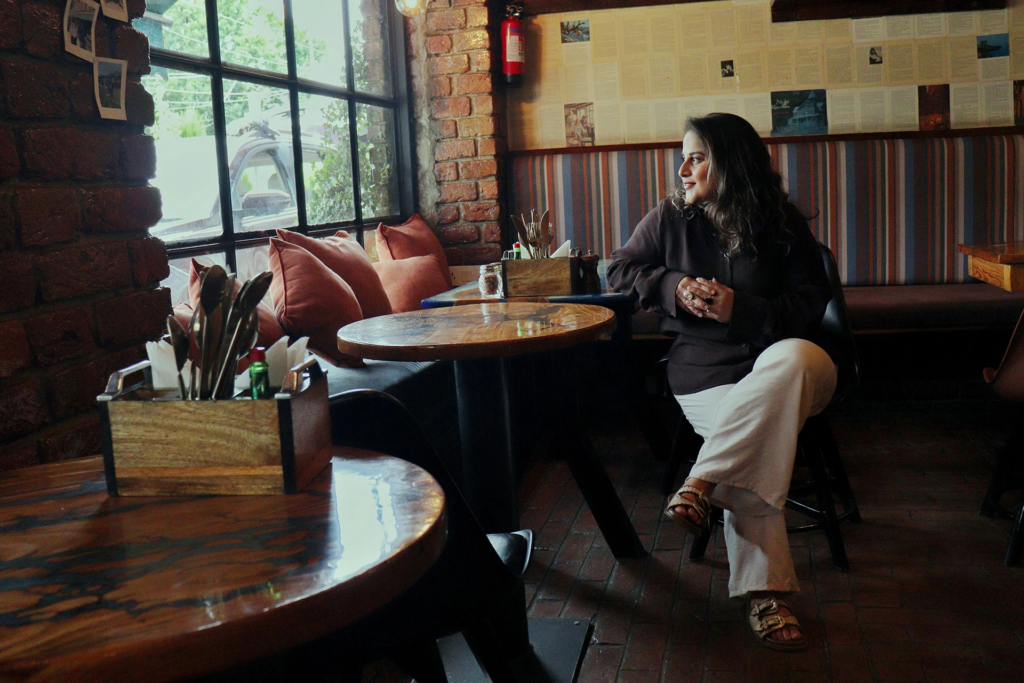
Books & Bricks sits across from Amar Singh College in the heart of Srinagar, one of the city’s independent cafes in Indian-administered Kashmir. Stationery shops line the roadside, Town Square Mall is nearby, and the usual university rush fills the streets. But inside, something shifts. Books are stacked on wooden shelves, their spines inviting browsing. Old newspaper clippings decorate the walls, and exposed brickwork lends the room a warmth that feels both curated and alive. It is the kind of place where an afternoon can disappear unnoticed.
Co-owner Anam Khan, 34, greets regulars by name, welcomes newcomers, recommends books, tests food, and pauses for conversation. In one corner, two friends discuss geopolitics over cappuccinos. Nearby, a woman works through her lunch break, laptop open and coffee cooling beside her. Others read, eat, scroll, talk, or simply sit.
In a Himalayan region often defined more by geopolitical conflict than by cappuccinos, a quiet revolution is unfolding in Srinagar’s cafes. Third spaces are emerging as anchors of community, creative expression, and economic resilience. Three women entrepreneurs are helping to build these spaces—from independent bookish cafes to international franchise outposts—that serve as offices, creative hubs, meeting places, and welcoming environments for a new generation of Kashmiris. Their stories, though distinct, converge on a shared belief: that a cafe can be more than a place to drink coffee.
Khan grew up in Kashmir and later moved to New Delhi to pursue a master’s degree in conflict analysis from Jamia Millia Islamia University. She built a career in public health as a communications specialist with USAID, working from community health centers in western India to the Ministry of Health and Family Welfare. She wrote stories, produced films, and documented the human impact of donor-supported initiatives.
Returning home was never simple. When Khan returned to Kashmir in 2018 after years away, she carried with her an idea she had encountered in a Delhi cafe: a place where people could sit, work, or talk without needing a particular reason. “I thought, ‘How lovely it would be if I had a cafe here in Kashmir,’” she recalls.
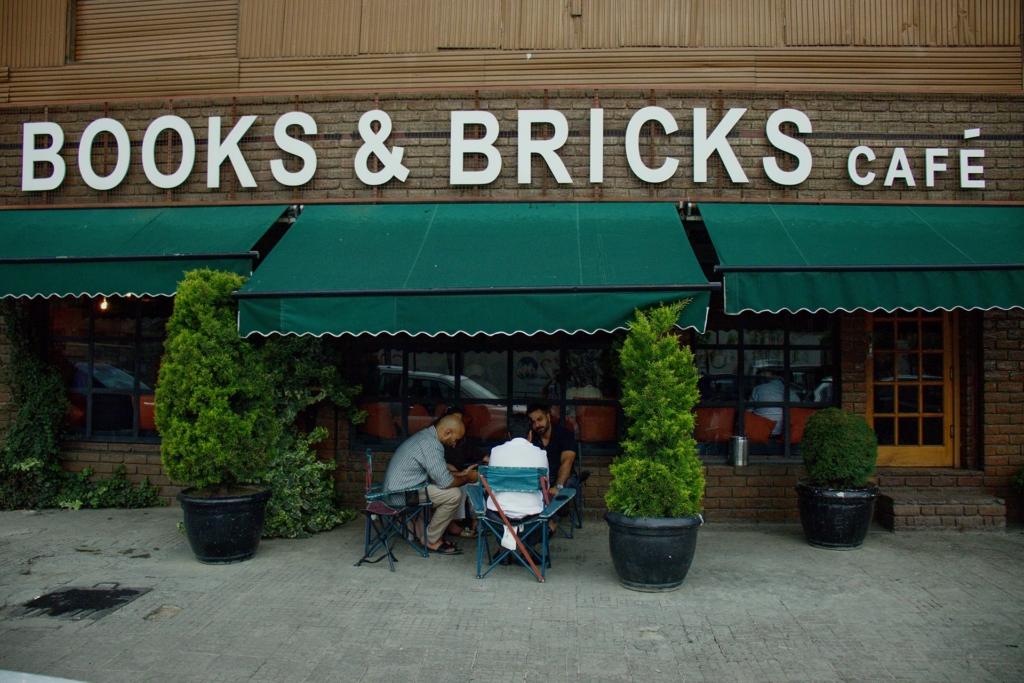
Books & Bricks opened in 2015. By early 2019, however, the business was struggling. Khan, then working on a public health project in Nashik, received a call from one of the cafe’s founders. They were considering selling. She offered to buy half of it, hoping they could find a way forward. The cafe reopened then.
Khan brought more philosophy than capital. She renovated the space, added seating, and made it more open—a place rooted in inclusion. Soon, the cafe found a life beyond its menu. Young writers arrived with poems; lawyers, journalists, and artists followed. Browsing, reading, and conversation became the norm. “I wanted this place to be inclusive,” Khan says. Her philosophy is simple: give people their own space while keeping them connected to a larger community. In doing so, she tapped into something deeper—a longing for connection that Kashmiris have always known.
Reviving a Tradition
Kashmir is known internationally for its landscapes and political complexities, but it also possesses rich culinary, craft, and cultural traditions. Families have long gathered at kandur shops for morning chats. These Kashmiri bakeries serve local breads such as girda and lavasa, often accompanied by noon chai, the salty pink tea that remains a morning staple. Weddings begin with elaborate multi-course wazwan feasts. Cafes offer a different kind of public setting—one where people can gather without a special occasion.
Coffee, meanwhile, is not new to the Valley. The India Coffee House on Srinagar’s Residency Road was once a vibrant meeting place for intellectuals, journalists, writers, scholars, and activists. During the 1970s and 1980s, it carried the literary and political energy associated with coffeehouses elsewhere, including those linked to the Beat Generation in San Francisco. The city’s public social life was later disrupted by militancy and decades of political instability. Today, Srinagar is home to hundreds of cafes, many of them run by women entrepreneurs. They are reviving that tradition with a spirit of gathering, dialogue, and belonging.
A few kilometers from Books & Bricks, another woman is building a community space with a distinct character of its own. Lounge by Just Baked, located near the city’s main tuition hub, is co-owned by Maria Bilal Lone, 34, who grew up in Kupwara in north Kashmir. After living abroad for several years, she returned and joined her family’s bakery business, which her father started in 2015. Two years ago, she partnered with a family friend to build the lounge. The place quickly became popular for creative events, including book readings, children’s activities, poetry nights, live music, barbecues, and cake-decorating workshops. “We do a lot of events here,” Lone says. “It really helped make our place more popular with people and give them a place to stay.”

The Lounge has become a comfortable space for young women and an informal office for remote workers, a trend accelerated by the pandemic. Laptops have replaced notebooks, and coffee tables have become workstations. “I often see young women sitting here for hours, working on their laptops or just reading a book,” Lone says. “It’s a safe place where they don’t have to justify why they’re here.”
Traditional Kashmiri, Mughal, Central Asian, and Indian cuisines still dominate the region’s restaurant culture. But a younger generation—many of whom have studied or traveled abroad—is increasingly ordering coffee, burgers, pizza, pastries, and international-style breakfasts. For cafe owners, however, it is easier to cultivate curiosity than consistency. New customers may be interested in trying something unfamiliar, but they return only when the food and coffee meet their expectations. “We never compromise on the ingredients. Everything is made fresh every day,” Lone says. In a growing market, that consistency has become a competitive edge.
The Third Space
While Books & Bricks and Lounge by Just Baked have cultivated loyal followings, a third entrepreneur is proving that even an international brand can become a local gathering place—if the intention is right.
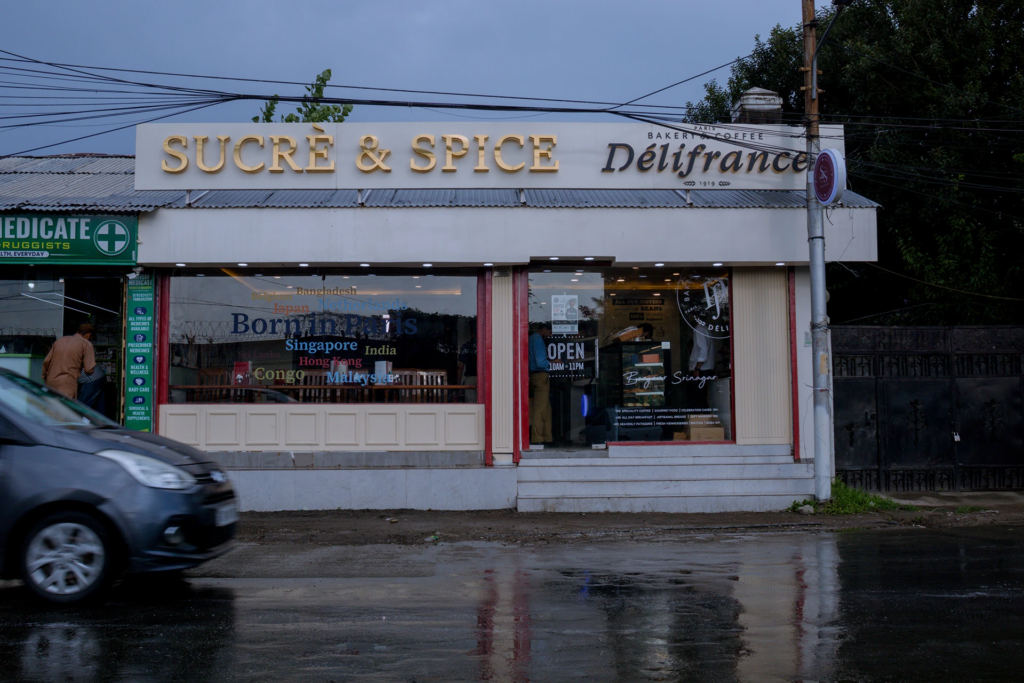
On a rainy evening, I walked into Délifrance Kashmir—branded locally as Sucre and Spice—the city’s newest outlet. The city had just been drenched after days of sweltering heat. But inside, the warm aroma of freshly baked croissants and the gentle hum of the espresso machine made it feel like a different world. Golden croissants, pain au chocolat, and delicate fruit tarts sat behind a glass counter—a scene that could have been in Paris. Yet, it was in the heart of Srinagar. The cafe was hosting its first “coffee cup meetup” for young entrepreneurs.
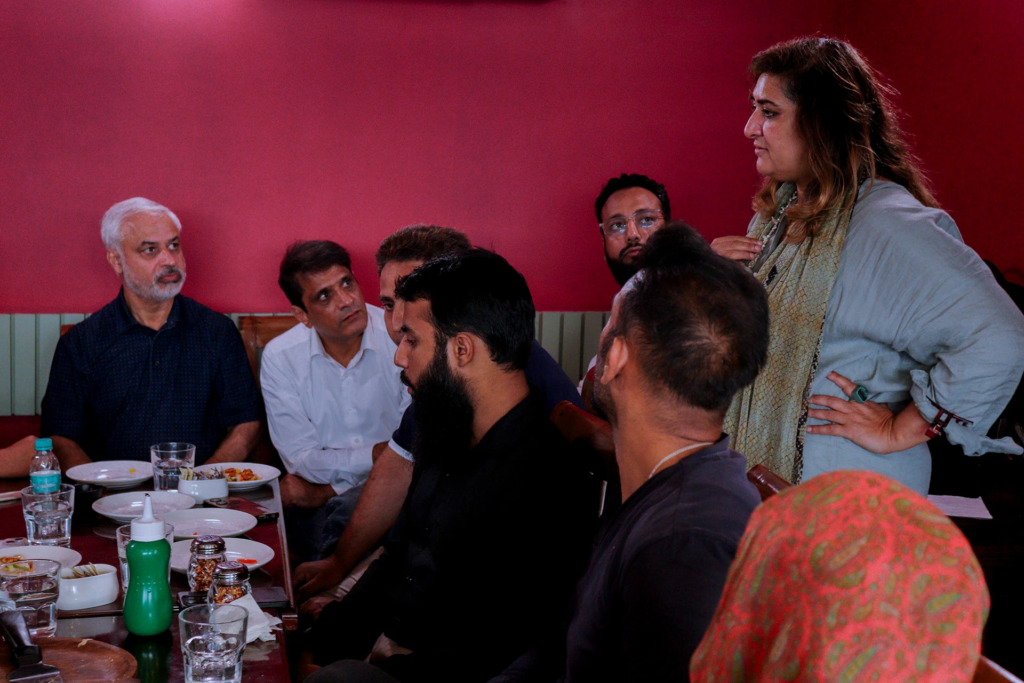
Entrepreneurs, founders, and doctors gathered around tables, their conversations spilling over the rims of espresso cups, with Tahir Qazi, CEO of iQusar LLC. There was no stage and no formal speeches—just conversation over coffee. For Khair Ull Nissa, 50, an entrepreneur, it was a small nod to Srinagar’s startup culture and a glimpse of how cafes can support mentorship and community building. “I see cafes as the new community centers,” she told me during the meetup. “We don’t have many public spaces where people can just show up and be part of something. These meetups are changing that.”
Born into a business family in Kashmir, Nissa left the region at 17. She spent decades abroad before returning. She had a master’s from the University of Leeds. Nissa runs Délifrance as the first international franchise in Kashmir. Her journey into the cafe business began with a different vision: a cafe for bikers traveling to the high-altitude Himalayan valley of Ladakh. With little experience in food and beverage, she turned to an established brand that could offer systems and training. “I realized that Kashmir is in the French bakery culture,” she says, connecting the global brand to a deeply local tradition of baking. That blend of international sophistication and local sensibility has made Délifrance a fresh addition to Srinagar’s evolving cafe scene.
Yet behind the croissants and espresso, the challenges of running a cafe in the Valley are tangible. She sources a specific 85 percent Arabica-Robusta blend, with 55 percent Ethiopian and 30 percent Indian Arabica, to build a distinct coffee culture.
Cafes are emerging across Srinagar—and beyond, into towns and villages—shaping a new generation of Kashmiris. “There was no place like this when I was growing up,” says a Books & Bricks regular. “You either stayed home, or you went to a restaurant where you had to order a whole meal. Now I can come here with my laptop, order a coffee, and stay for long hours. It’s a luxury.”
Back at Books & Bricks, Khan watches customers come and go. Seven years after joining the cafe, she sees the space she once imagined filled with people reading, working, talking, and staying longer than a meal requires. The coffee may be new, but the impulse behind the cafe is older: a search for a place to belong.
Ishtayaq Rasool is a freelance journalist based in Kashmir.