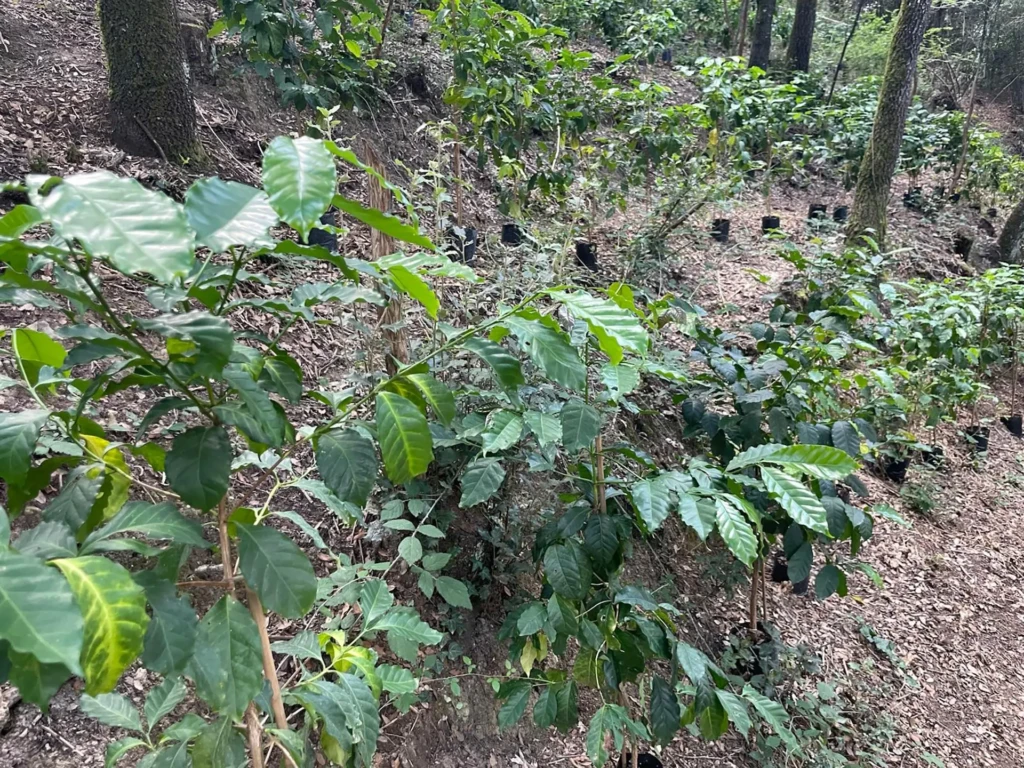
Nestled in a valley of oak trees, about 55 miles outside Barcelona, rows upon rows of Gesha and Castillo plants are steadily growing at Finca Castellvilar.
The nearby town of Torelló can dip to freezing temperatures in the winter—a far cry from the balmy tropics where coffee normally thrives. But the constant stress of the plants’ new environment only makes them stronger, according to the farm’s husband-and-wife owners, Joan Giraldez and Eva Prat.

Even in October, as temperatures dropped to 40 degrees, a handful of Gesha plants were still flowering. To Giraldez and Prat, the explanation is simple: evolution. “Just like there are foxes in the mountains, in the arctic and antarctica, in the desert—it’s a clear example of how an animal has adapted to different climatologies,” Giraldez tells me. “Why couldn’t this happen with coffee?”
With their modest harvest in 2024, Finca Castellvilar claimed the superlative of being the first coffee plantation outside of tropical or subtropical climates. As climate change shifts the boundaries of the coffee growing belt, Giraldez and Prat have proven coffee can grow outside of its traditional climate—which could mean the future of coffee growing in Europe is only getting started. On top of that, the farm is poised to close the coffee production chain: They plan to one day process the seeds from the fruits, roast the coffee, package, and distribute it—achieving the specialty coffee industry’s sought-after traceability in their product.
“Why not close the cycle?” Giraldez said.

Others have grown coffee in Europe. Elsewhere in Spain, the Canary Islands and Granada have small coffee farms. There’s one on a small island off the coast of Portugal. Sicily also has a couple coffee growing projects. But none of them reach the scale of Finca Castellvilar, which nurtures 5,000 plants at 42 degrees latitude, outside of a tropical or subtropical climate.
Though they grew up in neighboring countryside towns in Catalunya, Giraldez and Prat did not have much agriculture know-how before starting the project. He began in the world of coffee more than 25 years ago in the technical department of an espresso machine fabrication company, later moving into roasting and distributing. She helped run her family’s restaurant before becoming an accountant.
But one day Giraldez had a vision, which he admits sounds strange. He saw himself standing among coffee plants. That set into motion years of studying agriculture, soil pH, and local zoning ordinances, beginning in 2016. After searching for the right location, they found it in 2018: A 14-hectare valley of oak trees that creates a microclimate for the plants.
Giraldez and Prat obtained high-quality Gesha and Castillo seeds, and completed the first germination in 2019. The plants did not survive the winter, because the municipality had not granted the permits the farm needed to receive public water and electricity. But the gamble was not a total loss: They learned the plants would grow.
They germinated again the next year, then having built their own systems to collect rainwater and generate electricity from solar panels, as well as a greenhouse. The process took about eight months, whereas in countries of origin, germination might take just two months. But they’re patient.
“It might need its time, but it has a way,” Prat said.
Four years later, from April to September 2024, they harvested about 170 grams. Their harvest in 2025 brought the total to about one and a half kilos. The quantity is not as important as the fact that the plants are producing more fruit each year, they said. The hard part—the plant’s adaptation—is done.

They’ve achieved adaptation with other tropical fruits, too, including mango, avocado, lychee, and soursop, which are interspersed with the coffee plants and influence the coffee’s tasting notes. The farm’s high latitude and lower temperatures, compared to traditional growing regions, have a similar effect as high elevation, according to Giraldez. The coffee fruits mature more slowly, giving them more nuanced notes.
When Giraldez and Prat first tasted their coffee last year, they recognized the varieties’ typical characteristics and also detected the woodsy land it grew on, a flavor profile they believe will become more pronounced over time. “The Gesha still has its origin notes,” Giraldez tells me, “lightly fruity, floral. It also has notes from here, from the earth. In a way, the fruit already reflects the land.”

Finca Castellvilar also has 1,000 Catalan blueberry bushes, which gives nutrients to the coffee plants in symbiosis. And they have 10 Rasquera goats—typical to Catalunya but in danger of extinction. The goats graze the forest, clearing the ground for the coffee plants. They do barista trainings and welcome visitors at the farm, but Giraldez draws a distinction between his project and a scientific study. Unlike researchers who grow coffee plants in a laboratory, discarding the weaklings to produce the hardiest offspring, he studies each root while transplanting from seedling trays to soil bags to the earth, performing “surgery” when necessary for the plants that are slumping. His farm is a “laboratorio campo,” as he puts it—a field lab.
And they’ve done all this by themselves. As the plants mature, they are scouting places on their land where they can wash the seeds of their fruit, dry them, and roast them. They are planning to grow their team and offer more trainings for coffee professionals.

This year they plan to bring in a Q Grader to evaluate their coffee. But they didn’t roast all of it, last year or this year. More valuable than a cup of coffee is the seed that carries all the genetic information, they said. They’ve already germinated those seeds and are nurturing second-generation saplings that will be even more resilient, one day filling the valley with up to 28,000 coffee plants.
“You have to be conscious of the plant’s evolution,” Giraldez said. “We want our plants to be Oak Coffee, like Robusta on a name level, but with more flavor notes, a better plant.”
Elizabeth Moore is a freelance journalist based in Oaxaca, Mexico. This is Elizabeth Moore’s first feature for Sprudge.